Welcome to our weekly roundup, where we bring you market insights from different industries condensed into a quick and informative read. Buckle up, because whether you’re a business leader, policy fanatic, or simply curious about the region, this newsletter has something for you. Stay informed, stay engaged, and have a good weekend!
Demand for high-end residential units is growing on the back of policies such as the Transfer Duty Act which is said to have reduced duty rates for international buyers.
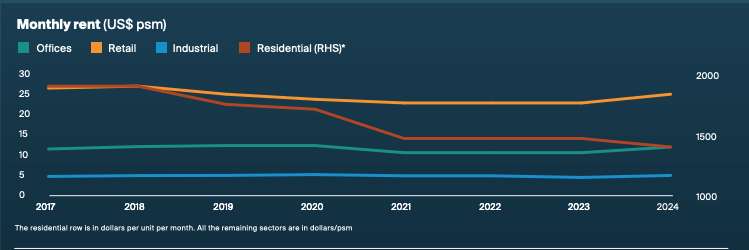
There have been increased inquiries for best-in-class offices, especially within the Gaborone CBD. Occupancy rates have experienced a 10% uptick over the last six months of 2023 ending last year at 95%. This trend extends beyond the CBD, encompassing areas such as the old Gaborone CBD and Fairgrounds.Despite the escalating demand for premium offices, monthly prime headline rents have held steady for the past two quarters (Q4 2023 and Q1 2024), and stand at between US$ 10-12 psm.
Image source: Knight Frank – The Africa Report 24/25
Malawi
Demand for CBD office spaces in Lilongwe and Blantyre is being suppressed by pandemic-related business closures and Q4 2023’s economic downturn. Parking issues and street vending are also said to be affecting uptake of offices in the CBD resulting in vacancy rates in the 20-30% range.
Retail occupants are moving to high-traffic areas within town centres in order to try capitalise on the higher footfall offered by such locations. These has resulted in low vacancy rates in key cities such as Blantyre, Lilongwe and Mzuzu with prime monthly rentals in the US$10psm in urban centres in these locations.
Mauritius
Transactional values for residential properties reached US$1.5bn in 2022/23 on the back of rising demand for luxury apartments and villas. Foreign buyers in France, South Africa and the UK contributed 68% of transaction volumes in that segment. Residential property prices have been on an upward trajectory since 2019 (averaging 10.9% increase annually) with Q1 of 2023 seeing “a sharp 35% rise in residential property prices.”
What of the famed tourism sector? Well, the 67% average hotel occupancy rates for 2023, led to revenue per available room surpassing 2019 levels in 4 and 5-star segments. Overall 2023 was considered a good year with 1.3 million visitors (95% of 2019 levels) indicating that the post-pandemic recovery might finally be complete…
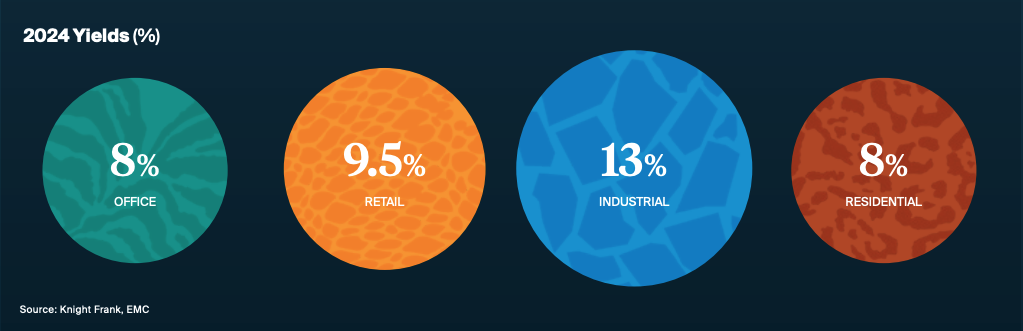
Image source: Knight Frank – The Africa Report 24/25
Mozambique
Rental rates in Maputo’s office market have been steadily declining sicne 2021 with rising inflation, a halted LNG (Liquified Natural Gas) project and security concerns all shouldering some of the blame. More positively, a recent deal saw GRIT Real Estate Income Group sign an 11-year lease agreement with Total Mozambique at the Commodity House Phase One development, resulting in a building occupancy of 95%.
South Africa
Industrial rentals are expected to grow in the medium to long term on the back of growing demand for premium warehouses. The growth of eCommerce over the years coupled with the arrival of Amazon in South Africa earlier this year bodes well for this segment which already saw vacancy rates fall by 5% in 2023. This rising demand has also seen warehouse rentals in Johannesburg increase by 2% to US$5psm over the last two years.
Return to office policies have also seen prime offices in Cape Town record a 10% increase in occupancy levels over the last two years. Part of this has been motivated by the country’s energy crisis which means for most businesses it’s easier to arrange backup electricity supply for workers in one centralised office than it would be if employees were working remotely. Talk about every action having an equal reaction as the great scientists say.
Zambia
The retail leasing landscape is particularly exposed to the kwacha’s fluctuations as leases in this segment are denominated in the US$ leaving both retailers and landlords exposed. On the more positive side, national infrastructure projects are “paving the way for the future success of neighbourhood malls and standalone outlets in the underdeveloped northern and north-western regions.”
Zambia’s office market has experienced a “steady rise in take-up” leading occupancy rates to rise by 7% to 90% by the end of March 2024. Average monthly prime office rents have been relatively stable at US$18 psm for the 3rd straight quarter
Zimbabwe
Occupancy rates in malls and newly-built shopping centres have been edging upwards with the shopping centres exceeding 80%. This has had the domino effect of leading to rental increases with “larger and centrally located retail units in Harare commanding monthly rents of between US$ 17-25 psm.” Frank Knight cites that the demand is driven by informal traders who require smaller units. This has led landlords sub-dividing spaces into these smaller units between 9-50 sqm. Monthly rentals for smaller shops has surged by 100% from US$20 (psm) in 2022 to US$40 psm by the end of 2023.
Knight Frank notes that prime residential rates are on the rise on the back of an influx of expatriates into the country driven by increased business. One example of the effect of this movement is that monthly rents for 4 -bedroom apartments have risen by 10% (around US$200) since the beginning of 2022 to US$3500 at the beginning of 2024.
Let’s talk about African healthcare (or lack thereof?)
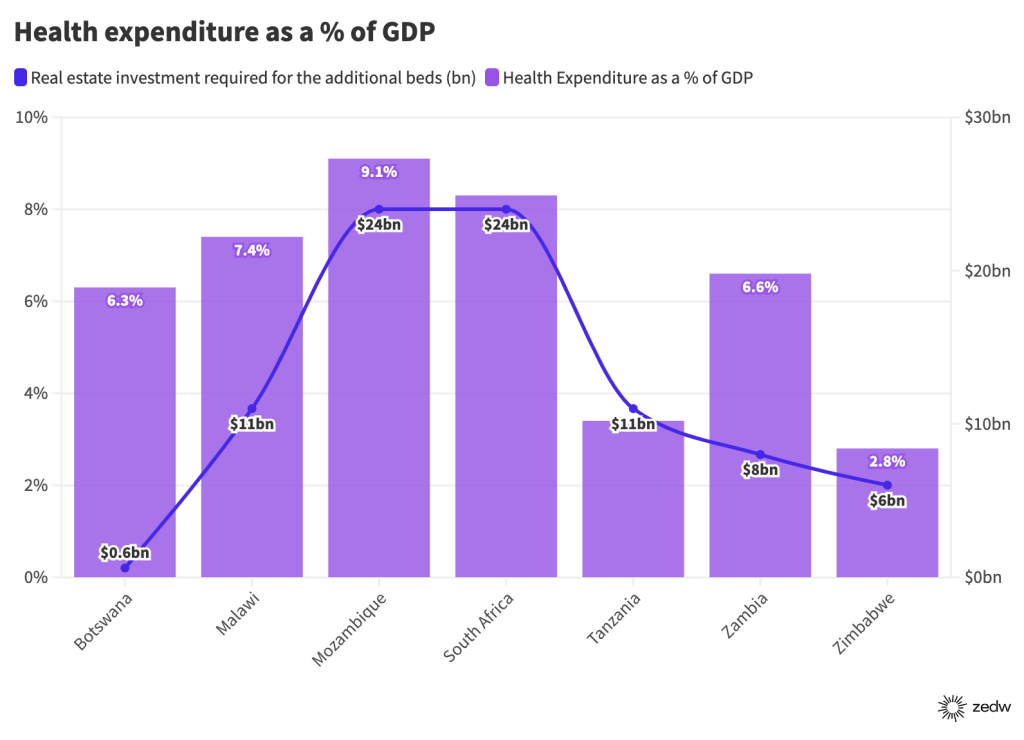
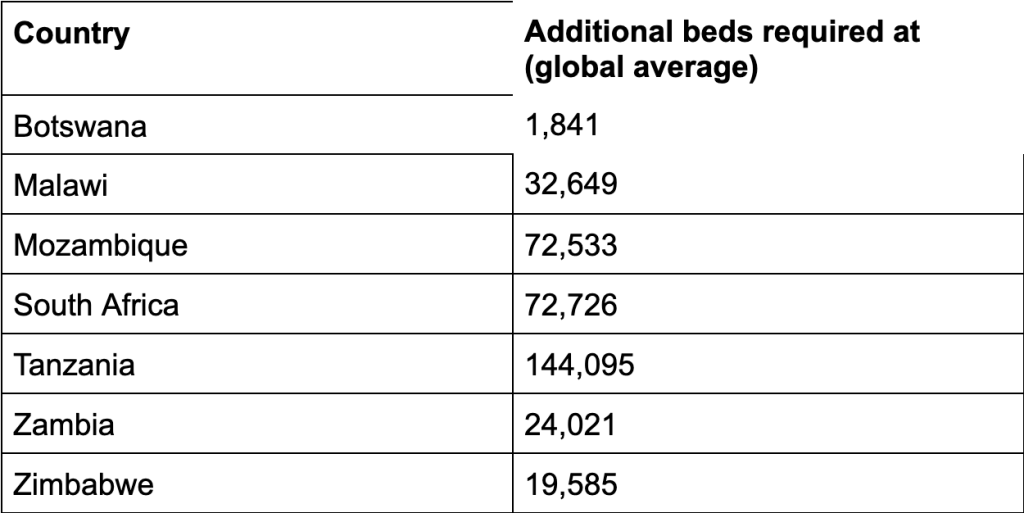
We decided to look at health data across 3 metrics (1. Health Expenditure as a % of GDP, 2. Additional beds required at global average and 3. Real estate investment required for the additional beds) from 8 countries in the region.
Naturally the first question was whether or not countries are spending enough on healthcare. Obviously, that’s a relative question but it seems to be lagging some of the developed countries
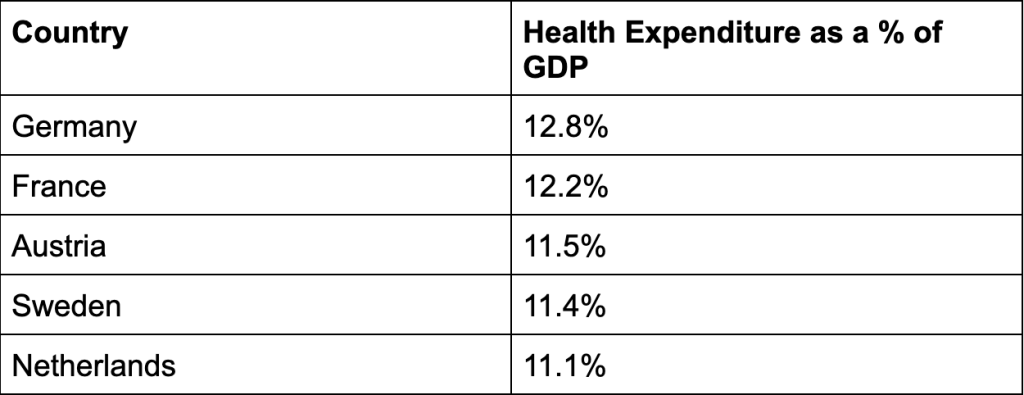
As a point of comparison, we looked at some developed countries in Europe to see how the above were faring and it’s not too encouraging;
Given this additional context it seems Mozambique and South Africa are doing relatively well but it’s clear that for a region that is already playing catch-up our governments might also not be investing enough to ensure the catching up actually occurs.
Demand for healthcare services is currently outstripping supply with the additional beds required (at global average) for the 8 countries in our sample looking something like this;
Farai Mudzingwa is a mixed-media journalist with 6 years experience. His written work tends to focus on tech, arts and business in Africa. He also publishes video/audio interviews profiling Zimbabwean creatives for Untold ZW.